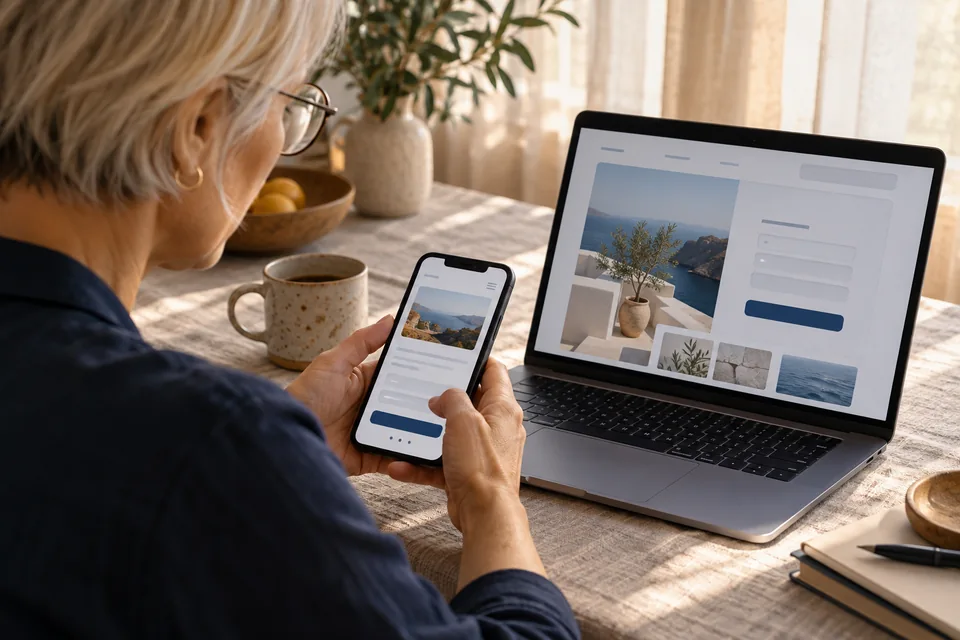

You know how much thought, experience and work go into serving each customer. A first-time visitor does not. To them, you may be one of several businesses promising “quality, reliability and personal service.” Your job is to discover what matters in their decision, identify where you meet that need and make the connection clear and credible.
Useful differentiation connects a real capability, a specific customer's important need and evidence you can show. If that connection improves decisions and lead quality, you can then evaluate its effect on acquisition costs and profitability.
1. Start with the customer you want to win
A differentiator matters in context. Someone who needs an urgent repair chooses differently from a manager seeking a long-term project partner. Both may buy from you, but they need different reasons to reach out.
Review customers and projects you would welcome again: successful, profitable work that suited your team. Look for shared needs, scope, geography, complexity or support requirements. Compare those with jobs that caused friction, overload or unpriced costs.
Define a primary audience for the page. “Service businesses managing inquiries across several areas” is more useful than “every business that wants to succeed.” You can create separate journeys when needs genuinely differ.
Your audience also shapes your examples. A law firm landing page starts with the practice area and type of inquiry. An architect's landing page emphasizes project types, planning stages and the scope of involvement.
- 01 / ABILITYWhat you do well
A real capability you can deliver consistently.
- 02 / RELEVANCEWhat matters to the customer
A need, concern or outcome they care about.
- 03 / PROOFWhat you can demonstrate
Relevant work, a process or experience.
2. Listen to why customers chose you
Business owners often emphasize what took the most effort to develop. Customers may value something else: clear explanations, organized scheduling, familiarity with a problem or someone taking responsibility. Listen to customer language to find the gap.
Start with short conversations with recent customers, repeat customers and prospects who declined. This is exploratory research, not a representative study of the whole market. Ask open questions before suggesting answers.
- What made you start looking for a solution?
- What alternatives did you consider, and what was hard to compare?
- What nearly stopped you from choosing us?
- What information or moment helped you decide?
- What proved most valuable once the work began?
- How would you explain to someone else why they should contact us?
Review inquiries, won and lost deals, recurring questions and voluntarily submitted reviews. Record patterns without publishing personal information. Verify and obtain appropriate permission for public quotes; a research conversation is not automatically a testimonial.
The same principle applies to candidates: a recruitment landing page should explain the work, environment and expectations to attract people who fit the role.
 Planning & setup
A shared brief connects business goals, audience needs and project deliverables.
3. Turn assumed strengths into verifiable facts
Collect facts. Replace “we're professional” with what your team can do and under what conditions. Replace “great service” with how service actually works. A strength might be a product, specialized expertise or a repeatable process.
On mobile, swipe the table horizontally
| Area | What to look for | Possible evidence |
|---|---|---|
| Expertise | Which problems or customers do we understand especially well? | Documented work, training or a case study |
| Process | What makes working with us clearer and more predictable? | Defined stages, a written scope, a handoff document |
| Fit | Who is our solution particularly well suited to? | Examples of similar needs or projects |
| Service & support | What happens before and after the purchase? | Contact channels, defined warranties and support scope |
| Operational efficiency | Where do we save the customer effort or coordination? | One point of contact, connected systems or an organized workflow |
Define the limits of each strength: which service it applies to, who delivers it and when it does not apply. If it relies on one person's extraordinary effort, consider whether you can sustain it as demand grows.
Clear limits make messaging stronger and more credible. A precise commitment you can deliver is more useful than a sweeping promise that disappoints after the sale.
4. Study the alternatives customers actually consider
Alternatives may include another provider, a cheaper solution, doing it internally or postponing the decision. Consider the benefit and concern each option creates from the customer's perspective.
Study pages and offers addressing similar needs: their audience, scope, proof and unanswered questions. Base conclusions on observable information. A competitor's website omission does not prove they lack a capability.
Find a relevant reason to choose you. Your strength need not be entirely unique; your combination of specialization, process and support may fit a particular audience especially well. Clear value does not require claiming you are the only provider.
5. Evaluate your differentiator with four questions
A long list of benefits is not a central message. Choose one leading idea and a few supporting proofs. These four questions separate a nice-sounding statement from a practical reason to choose you:
Does the customer care?
The benefit addresses a difficulty or concern raised in real conversations.
What does it change?
You can explain a tangible benefit beyond an adjective like “advanced.”
How can someone verify it?
Work, a process, contextualized data or documentation supports the claim.
Can we deliver it again?
The promise fits the business's capabilities, pricing and workload.
For example, “one point of contact throughout the project” may reassure customers worried about coordinating vendors. Explain that person's responsibilities and what remains with the customer. An operational feature then becomes reduced uncertainty.
If an idea fails one of these checks, refine the message or build the missing capability. Bigger type cannot compensate for missing evidence.
6. Translate capabilities into customer benefits
Customers need to understand what your capabilities do for them. “An automation system” names a tool; “inquiries arrive with the service and location attached, so the conversation starts with context” explains its value. Describe the process you actually deliver.
We help [a specific audience] address [an important need] through [a clear approach]. You can see this in [relevant evidence].
Use this as a thinking tool, not mandatory published copy. Turn it into a concise headline, supporting explanation and proof. Check whether someone outside your industry can understand the offer.
“Professional IT services for businesses”
Possibly true, but it gives customers little reason to prefer this provider.“IT management for small offices, with one point of contact for support and vendor coordination”
Use this only if you provide it. Then show the scope, limits and an example of your process.Explain who the service is not for as well. This helps visitors qualify themselves and may save sales time even if total form submissions do not increase.
7. Bring your difference into every part of the page
Carry the core message from the ad to the opening screen, explanation and call to action. Google recommends aligning ads, keywords and landing page content. Google's guidance on ad and landing page relevance — opens in a new tab ↗
- Headline: names the service and central benefit.
- Supporting copy: explains who the service fits and how it works.
- Image or demo: shows work, a process or a product that supports the message.
- Benefits: connect capabilities to customer value through specifics.
- Evidence: addresses the doubt standing between the customer and the next step.
- Form and button: offer a next step appropriate to the decision.
If your difference is transparency, show scope and stages. If it is specialization, show relevant work. If it is easy coordination, explain who guides the customer. Hierarchy, spacing and consistent presentation make that information easier to understand.
On mobile, keep the message and next action in a logical order. Do not bury evidence under a long image sequence. Strong design can impress without making visitors wait for an animation to understand what you do.
Apply landing page design principles to these decisions: what visitors see first, which evidence supports the promise and how they move toward an inquiry.
 Design & hierarchy
Color, spacing, imagery and typography create a hierarchy that guides attention to what matters.
8. Build evidence that reduces doubt
“We know how” is a claim. Describing a problem, decision and outcome gives readers a way to judge it. Choose evidence that answers the question at hand: similar experience, workmanship, service or industry knowledge.
A useful case study explains the starting point, challenge, work and constraints. Put numbers in context with a timeframe and defined metric. Campaign, pricing and sales-process changes can also affect results; do not attribute everything to the page.
New businesses can show relevant training, work they have permission to share, clearly labeled demonstrations or a detailed process. Describe what exists instead of inventing reviews or results.
 Portfolio & proof
A real business should show its own work, explain what was delivered and highlight relevant details. This image illustrates one way to present a portfolio.
9. Shape an offer that attracts the right people
Even strong differentiation needs a clear offer: what is included, who it fits, what requires customization and what happens next. A compelling headline without detail may generate curiosity but leave sales teams with unready or irrelevant inquiries.
For complex services, invite prospects to a fit assessment or discovery call and explain its purpose. For simpler services, offer a quote request with the necessary details. Match the wording to the actual process: a callback form is not a confirmed calendar booking.
Service, location or project-scope questions can help qualify leads when they serve a purpose. Avoid adding fields merely to look thorough. Explain why information is requested, keep entry easy and verify that submissions reach the right place.
Do not default to a discount. It may increase inquiries while reducing each sale's contribution. Clear scope, an assessment or defined support can give customers a reason to proceed without lowering the price.
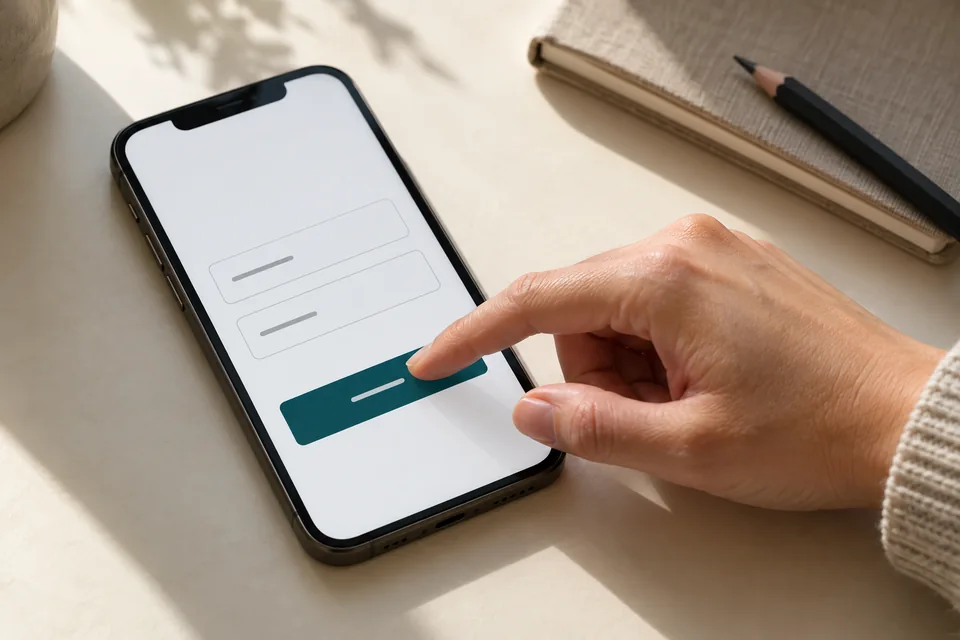 Mobile forms
Start with the information needed for the next conversation. Mark optional fields, explain what happens after submission and make buttons easy to tap.
10. Use dynamic pages to highlight the relevant strength
A business can have several strengths, each relevant to a different need. Someone with a breakdown wants a clear response process; someone planning an upgrade wants options and a project plan. Adjust the emphasis while keeping the brand and promises accurate.
Map each service to a customer need, headline, explanation, proof and relevant form question. A dedicated link or an explicit visitor choice can set the context. Always provide a complete default page and a way to correct the service or location.
For example, a locksmith page about cylinder replacement can explain compatibility and scope. A lockout journey can explain how the situation is assessed and the first step. This illustrates content choices; it makes no claim about a particular business's price or availability.
Dynamic personalization puts the relevant differentiator in front of the right visitor. It still needs a strong offer, evidence and measurement. Explore the dynamic landing page guide for more.
11. Understand which costs you can influence
“Lower advertising costs” can mean total spend, cost per click, cost per lead or customer acquisition cost. These are different measures. Generating more inquiries from the same traffic can lower cost per lead while clicks and total spend cost exactly the same.
Cost per leadMedia spend ÷ inquiries received
Media cost per acquired customerMedia spend ÷ new customers attributed to it
Total acquisition costAlso includes other marketing and sales costs, according to your accounting method
More paying customers also require lead quality and close rates to hold up. Doubling submissions from people outside your service area can consume more time without increasing profit.
In Google Ads, landing page experience is a component of the Quality Score diagnostic. The displayed score is not itself an auction input. No formula guarantees that new copy will lower CPC. Google's explanation of Quality Score — opens in a new tab ↗
Decide whether the goal is more customers at the same spend or the same customer target at lower spend. The latter requires separate testing: budget changes may alter traffic and performance, so it does not follow automatically from a calculation.
 From ad to landing page
An ad sets an expectation. The page's image, headline and offer should continue that conversation and make the next step clear.
12. A worked example: from conversions to business value
This example uses Israeli shekels (ILS). Assume media spend of ILS 6,000, an average CPC of ILS 6 and 1,000 attributed visits. Compare inquiry rates of 4% and 8%. In both scenarios, 60% of leads qualify and one-quarter of qualified leads become customers.
This is a mathematical illustration—not a forecast, industry benchmark or client result. Assumptions stay fixed to show how the metrics relate. In practice, traffic quality, pricing and service capacity can change too.
On mobile, swipe the table horizontally
| Metric | Scenario A | Scenario B |
|---|---|---|
| Media spend | 6,000 ILS | 6,000 ILS |
| Visits | 1,000 | 1,000 |
| Inquiry rate | 4% | 8% |
| Inquiries received | 40 | 80 |
| Qualified leads — 60% | 24 | 48 |
| New customers — 25% of qualified leads | 6 | 12 |
| Media cost per lead | 150 ILS | 75 ILS |
| Media cost per new customer | 1,000 ILS | 500 ILS |
| Revenue — ILS 3,000 per customer | 18,000 ILS | 36,000 ILS |
| Direct costs — ILS 1,800 per customer | 10,800 ILS | 21,600 ILS |
| Contribution after direct costs and media | 1,200 ILS | 8,400 ILS |
| This contribution as a share of revenue | About 6.7% | About 23.3% |
The calculation subtracts direct fulfillment costs and media spend from revenue. All figures exclude VAT and use a consistent basis. Fixed costs, other sales and marketing expenses, financing and taxes are excluded. The final row is therefore not the business's net profit margin.
In this example, spend stays the same. Media cost per customer falls and contribution after media increases. Add any extra service, labor, discount or refund costs that come with growth. Higher conversion is financially valuable only when additional customers contribute more than they cost to acquire and serve.
13. Track whether differentiation works beyond the form
Form a testable hypothesis: “Showing scope and delivery stages will help business owners concerned about uncertainty inquire.” Make a focused change and track inquiry rate, qualification, meetings, sales and contribution. Changing the entire page at once makes attribution difficult.
Record the lead source and page version in your CRM alongside qualification reasons. Agree on what a qualified lead means and prevent double counting. A call or WhatsApp click indicates intent; it does not prove a conversation or message took place.
With enough traffic, run a controlled comparison. Set the primary metric and decision criteria in advance, and allow time for sales to mature. Comparing a busy week with a quiet one does not establish that the new message caused the change.
At low traffic volumes, start with comprehension tests, customer conversations and lead quality. Remove clear obstacles and gather evidence without calling a handful of deals statistical proof. If clicks rarely become inquiries, read why landing pages don't convert.
Evaluate messaging alongside lead quality and follow-up. Our landing page conversion optimization guide explains how to define metrics and compare changes without claiming unverified effects.
14. Exercise: turn your strengths into a page brief
Bring together the owner, a salesperson and someone who delivers the service. Each sees a different part of the experience. Start with facts and examples before writing the message.
- Choose one audience. Describe their need, situation and reason for looking now.
- Review three customer decisions. What persuaded them, delayed them and proved valuable afterward?
- List five strengths. Attach a benefit, evidence and a limit to each commitment.
- Choose a leading message. Test its relevance, impact, evidence and consistency.
- Draft the opening screen. Include a headline, explanation, one proof point and the next step.
- Map the page. Give each customer question an answer and a suitable place.
- Define success. Track conversion, quality and acquisition cost alongside contribution.
Before handing the brief to a designer
- You can explain the intended audience in one sentence.
- The message describes a benefit customers understand.
- Every important promise has a real capability and evidence behind it.
- There are no sweeping claims or numbers without context.
- The offer and action match the actual process.
- The main concerns are answered before the form.
- Your team agrees on what makes a qualified lead.
- Success will include customers and contribution, not just submissions.
The result is a brief connecting business reality with the customer's decision. Use it to present your strengths persuasively, then improve the page based on actual inquiries and sales.
This brief is a strong starting point for building a landing page that communicates your strengths consistently. Our landing page launch guide adds practical planning for materials, approvals and handoff.
Questions about differentiation, conversions & profitability
What if our service resembles our competitors'?
Look for audience fit, specialization, process or a service combination that matters to customers. You need not be the only provider. If no valuable, provable difference exists, improve the offer first.
Can a low price be our main differentiator?
It can be part of the offer if your cost structure supports it sustainably. Check what remains after fulfillment, acquisition and customer service. More sales alone do not establish better profitability.
How many benefits should a page emphasize?
Start with one central message and several supporting proofs. There is no universal benefit count. Each should help customers assess fit or resolve doubt.
Does better conversion necessarily lower CPC?
No. More outcomes from the same traffic can reduce cost per lead or customer even when CPC stays unchanged. Distinguish click cost, media spend and acquisition efficiency.
How do we show differentiation with few customers?
Show verifiable capabilities and processes, clearly labeled examples and work you have permission to publish. Never invent reviews or results. Collect documented experiences and permissions as the business grows.
How do we know the new message increased profit, not just leads?
Connect lead source and page version with qualification, sales, revenue and cost data. Compare similar conditions, allow sales to mature and evaluate contribution after relevant costs.
Images in this guide were created with AI for illustration. They do not depict actual clients, team members or campaign results.