

The decision is about more than one page versus several. What journeys help customers learn about the business, understand a service and choose to inquire? A single campaign offer needs something different from a company with several divisions and an ongoing content program.
Understand the practical difference
A landing page focuses on a defined offer, audience and action. A business website covers broader services, company information, work, insights and contact options. Websites can contain landing pages, and landing pages can share an existing domain.
Consider what visitors know on arrival. An ad click expects a focused continuation; a company-name search may need an introduction to the team and capabilities. Good structure serves each journey without showing everyone everything.
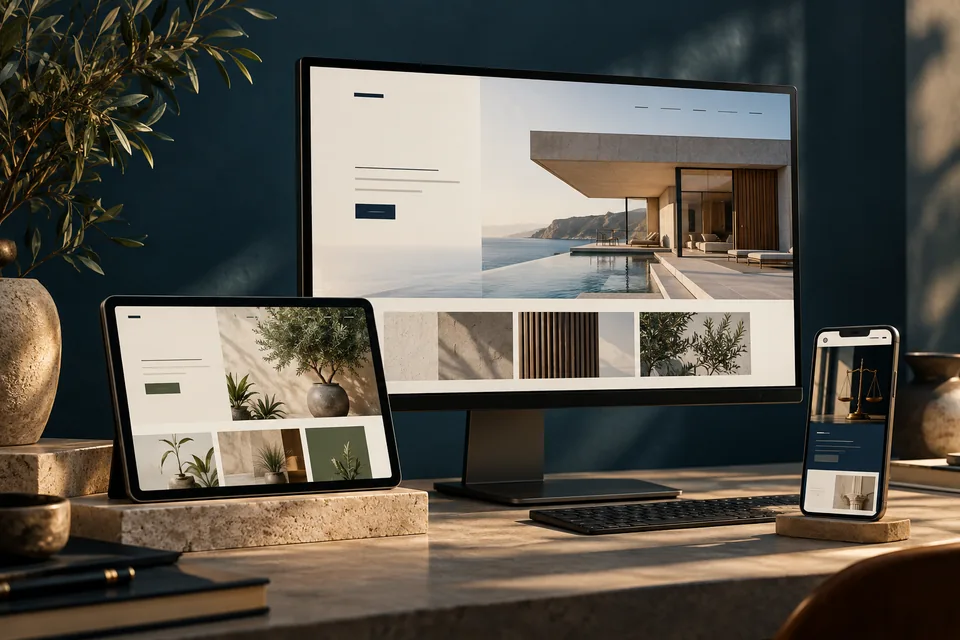 A landing page system
Decide when you need a separate page and when one system can adapt the content.
When is a landing page a good starting point?
A distinct offer, clear audience and primary action often suit a focused page: webinar registration, a demo request or a specific installation campaign. The page can still include detailed content, FAQs and a portfolio. Focus describes the decision, not a mandatory word limit.
A service business may cover related situations within a dynamic landing page. Personalization should address real differences. Shared teams and processes may not require dozens of pages to get started.
 Examples & inspiration
Study who a page is for, how it communicates value and what helps readers take the next step.
When does a business website offer more?
Different services, audiences and ongoing expertise publishing often need room to explore topics separately. About pages, detailed portfolios and guides support reading journeys that do not have to end immediately in an inquiry. Visitors can return to and share specific information.
Partners, candidates and existing customers visit too. Squeezing their different needs into one screen complicates navigation. A recruitment page can live within the site while keeping candidate content and actions separate from customer journeys.
 Search & intent
Search terms open a conversation. The page should explain how your service meets the need and where it is available.
What does your business need now?
A starting point for planning around your primary goal.
A focused offer. A clear action.
A dedicated landing page may fit, with enough information to decide.
Give each service room to explain its value.
Separate website journeys can simplify navigation and maintenance.
Connect the campaign to the right offer.
Add a focused page to your existing site while preserving the brand.
Illustrative scenarios. Adapt them to your business's actual offer.
Compare use cases, not just starting prices
A lower quote may fit, but first check writing, design, mobile adaptation, integrations, maintenance and ownership. Compare equivalent scopes. A personalized checkout page may be more complex than a small business website.
Consider who updates content after launch. Weekly publishing needs a different editing process from seasonal offer changes. Our WordPress, Elementor and Wix comparison separates the site's purpose from platform selection.
Scroll horizontally to compare
| Need | Focused page | Multi-page website |
|---|---|---|
| Single-service campaign | Direct route to the offer and inquiry | Can include a dedicated campaign page |
| Several distinct services | Requires careful selection or separation | Allows dedicated content and URLs for each service |
| Ongoing expertise publishing | Can link to a guide library | Supports a managed library and navigation |
| Testing a new offer | Allows a clearly scoped starting point | Can expand as needs develop |
Sometimes you need a website plus campaign pages
The website houses the brand; campaigns point to relevant offers. Share design language, forms and lead handling while tailoring openings to services and traffic. You do not need to rebuild the whole company presence for every campaign.
Internal links should help readers. A guide can point to the service applying its advice; a service page can link to decision-supporting information. Our landing page SEO guide covers the foundations. More pages alone do not guarantee rankings or traffic.
 Inquiries & follow-up
Connect each inquiry to its source, assign follow-up ownership and track qualification and the next conversation.
Plan for growth without building everything now
Start focused while allowing future portfolios, guides or services. Establish domain ownership, content storage and the process for adding pages. If expected growth needs a CMS, consider that before choosing a quick, inexpensive setup.
Conversely, a vague future possibility does not justify a large site now. Prioritize current and expected needs. Our landing page launch guide helps define scope and handoff checks for comparable proposals.
 Website platforms
Platform choices include editing, maintenance, integrations and handoff—not just the initial appearance.
Three questions that clarify the decision
Does most traffic share one primary action? Are services similar enough for one journey? Will you regularly publish and manage distinct content? These questions are not a formula, but they focus the planning conversation.
Bring real customer questions. Repeated confusion between services may need comparison content or separate pages. Customers who already know what they need may benefit from a direct scheduling path rather than a sprawling experience.
Bring a journey map to the planning call
Sketch traffic sources: search, social, referrals, returning customers and shared links. For each, note what the person seeks and their next step. One nontechnical page is enough to turn “what kind of website?” into a discussion of specific needs.
Our landing page service examines the journey, content and integrations. We can plan one focused page when appropriate or define a broader structure around actual needs rather than an arbitrary page count.
Ready for the next step?
Check off what you already have. This checklist stays on this page; selections are not submitted or saved after a refresh.
Common questions
Can a landing page appear in Google search?
Yes. Useful, crawlable pages can be indexed. Page count and visual style do not guarantee rankings; relevant content, technical foundations and other factors matter.
Can we add a landing page to an existing website?
Usually, subject to the platform and technical access. Verify branding, forms, measurement and navigation in the new page.
Which costs less?
It depends on scope and maintenance. Compare writing, design, journeys, integrations and testing—not just the labels “page” and “website.”
Images in this guide were created with AI for illustration. They do not depict actual clients, team members or campaign results.