
You've earned the click. Now the page must help the right person understand the offer and feel ready to reach out. Dynamic personalization lets you test whether a message tailored to the service, location and intent produces more relevant inquiries. Measurement tells you whether it does.
Define success before changing the page. Evaluate conversion alongside lead quality, cost and downstream outcomes. Separate impressions from evidence.
First, define what counts as a conversion
A conversion is a predefined action, such as a confirmed form submission or a call measured under a clear rule. Button clicks reveal engagement but do not necessarily represent inquiries. Distinguish progress events from the business outcome you want.
For page analysis, you might define conversion rate as visits with a valid inquiry divided by included visits, multiplied by 100. Apply the same definition to both versions, filter duplicates and tests consistently, and document the time window.
An illustrative calculation, not a client result or forecast. This comparison alone does not prove the page change caused the difference.
Find the gap between the ad and the page
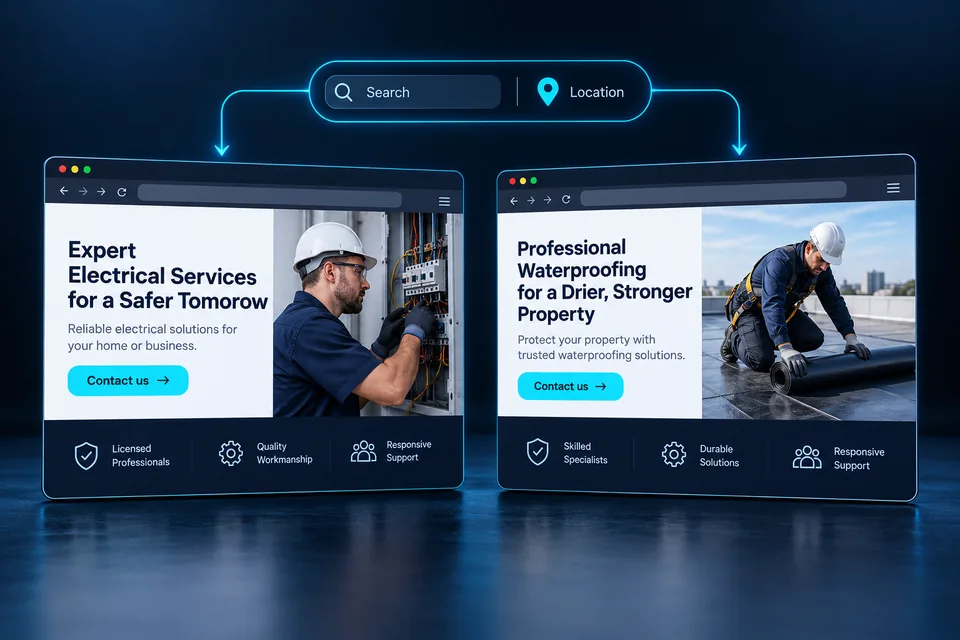
Follow the journey as a customer. What did the ad promise? What appears first? Are the service, location and next step clear? If an ad promotes lock replacement but opens a general maintenance page, the visitor must make the connection themselves.
Dynamic content gives each intent group a relevant opening, explanation and call to action. Google also recommends matching ad messaging to the landing page and making the next action clear. Google's guidance on ads and landing pages — opens in a new tab ↗
Write a focused hypothesis: visitors from an HVAC installation campaign may be more likely to complete the form if they immediately see what is needed for an estimate. That is testable. “Make the page more impressive” does not define the behavior you expect to change.
Start with our dynamic landing page guide to plan the messaging sequence: what changes, which information drives it and how to maintain a clear default version.
 From ad to landing page
An ad sets an expectation. The page's image, headline and offer should continue that conversation and make the next step clear.
Five areas worth testing
- A clear promise. A headline naming the service and audience, followed by a relevant opening.
- Relevant evidence. A genuine example, project or testimonial that addresses a service-specific concern.
- Decision-making information. What is included, what needs clarification and what happens after an inquiry.
- A focused form. Clear fields and a brief explanation for information whose purpose may not be obvious.
- An unmistakable next step. A descriptive button placed where visitors have enough context to act.
Do not change everything in every test. A complete redesign can show whether the overall experience performs better, but makes individual contributions harder to identify. Match the test's scope to the business question and available traffic.
Design supports clarity through hierarchy, spacing, contrast and readable text. Animation and large images help when they explain or focus attention. Change them if they obscure the offer or delay use.
Consider hierarchy, forms and action placement together. Our landing page design guide explores these choices through reading order and mobile usability.
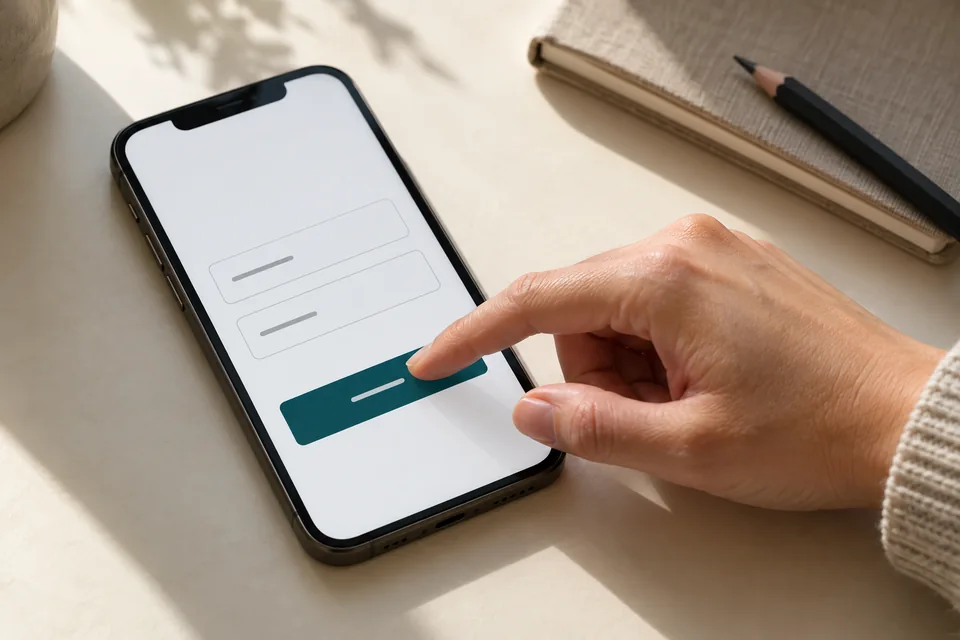 Mobile forms
Start with the information needed for the next conversation. Mark optional fields, explain what happens after submission and make buttons easy to tap.
Design an A/B test you can learn from
Compare the baseline and personalized versions with randomized, consistent assignment where the system supports it. Keep campaign conditions comparable and record changes in spend, audiences, offers and availability. A changing traffic mix can explain a performance gap independently of the page.
Scroll the table horizontally
| Component | Define in advance |
|---|---|
| Hypothesis | A service-specific opening will help relevant visitors complete an inquiry |
| Test audience | Visits from a defined campaign and service, with consistent inclusion rules |
| Primary metric | Share of visits with a valid inquiry |
| Guardrail metrics | Qualified lead share, cost per valid inquiry and form errors |
| Decision rule | Duration, data requirements and analysis method set before reviewing outcomes |
No universal visit count makes every test reliable. Data requirements depend on the baseline rate, effect size and analysis method. Early results can change; a few inquiries do not establish a winner. Label insufficient evidence inconclusive and decide what to test next.
Keep visitors in the same version throughout the journey and record the version with each conversion. Otherwise, you may attribute an inquiry to an experience the customer never saw.
Separate more leads from more opportunities
A page can generate more inquiries while becoming less useful to the business. Removing a service-area question may increase submissions from places you do not serve. Connect page measurement to CRM statuses and disqualification reasons.
Scroll the table horizontally
| Metric | Baseline version | Personalized version |
|---|---|---|
| Visits | 1,000 | 1,000 |
| Valid inquiries | 40 | 60 |
| Conversion rate | 4% | 6% |
| Qualified leads among inquiries | 30 out of 40 | 30 out of 60 |
| Qualified inquiries as a share of all visits | 3% | 3% |
Here, inquiry conversion rises by two percentage points—a 50% relative increase—but qualified lead volume does not rise. The message or form may still need refinement. These figures illustrate a distinction; they establish neither statistical significance nor expected performance.
Add media spend to calculate cost per valid and qualified lead. Define any additional costs included in total acquisition cost. Allow an appropriate period for calls and sales to mature based on your sales cycle.
Qualification differs by industry. A law firm landing page considers whether the inquiry fits a practice area. A remodeling contractor's landing page may also need project type and scope before deciding whether to proceed.
Apply the same discipline when comparing a Facebook lead form with a landing page. Cost per submission is not enough; assess contactability, service fit and actual next steps.
 Inquiries & follow-up
Connect each inquiry to its source, assign follow-up ownership and track qualification and the next conversation.
Speed and mobile usability are part of conversion
Personalization cannot rescue a difficult experience. Check that key content loads promptly, controls respond and layouts remain stable as visitors tap. Core Web Vitals address loading, responsiveness and visual stability. They diagnose experience, rather than directly measuring conversions. About Core Web Vitals — opens in a new tab ↗
- Serve appropriately sized images and reserve their space before they load.
- Test every headline variation on narrow screens, including long city names.
- Keep forms and buttons usable with keyboard navigation and enlarged text.
- Use real-user data when available alongside lab tests.
Mobile is also a usage context: visitors may be traveling, on a weak connection or interrupted. Focused paragraphs, readable fields and preserving entered information make reaching out easier.
 Testing & improvement
Usability testing reveals questions, friction and confusion that reports alone can miss.
Make improvement a regular practice
Build an evidence-based opportunity list: recurring questions, irrelevant service-area leads, error-prone fields or services with low inquiry rates. Prioritize by potential impact, strength of evidence and implementation effort.
Document each hypothesis, change, audience and result. Adopt improvements that meet your predetermined criteria. Keep the lessons from unsuccessful tests and ask a better next question. Your landing page can evolve with the business instead of remaining frozen after launch.
If the inquiry journey needs rebuilding, explore our landing page development service. To identify the problem first, why landing pages don't convert provides a structured diagnosis.
A few more useful questions.
How soon can we tell whether dynamic content improved conversions?
It depends on traffic, baseline conversion, effect size and the sales cycle. Set a measurement plan before launch and avoid conclusions without enough data.
Can a dynamic page fix a campaign targeting the wrong audience?
It can clarify the service and filter some inquiries, but traffic sources, targeting and the offer also need attention. Evaluate the whole journey rather than assigning all responsibility to the page.
Can we start without a complex CRM?
Yes, with consistent records of inquiries and outcomes. As volume and team size grow, a CRM helps centralize information, assign follow-up and connect page versions to business results.
Images in this guide were created with AI for illustration. They do not depict actual clients, team members or campaign results.